
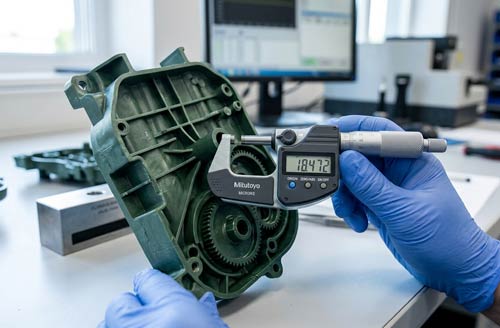
When it comes to high-precision injection molded parts, the leap from design to physical parts is a big one. It’s critical to make sure that the production run meets design and performance design requirements. This is exactly what First Article Inspection is for. But it’s much more than the name implies. Instead of just checking the first few pieces, it’s a full-scale audit of the entire molding process. From the mold and material to machine settings and more, nothing is off the table. Today, we will outline the inspection process, particularly for complex molded parts.
The Need for FAI
Before we dive into the steps, let’s take a closer look at why they need to happen. With demanding applications, such as those in medical, aerospace and automotive industries, failure is simply not an option. Failure can lead to safety issues, loss or property and even more catastrophic circumstances. Since the costs are high, every precaution must be made during the manufacturing process.
The Checklist
When dealing with complex geometries and tight tolerances, visual checks alone are insufficient. The process required much more to include dimensional verification, material and chemical validations, as well as functional and destructive testing. Each of these three pillars consists of multiple considerations as follows:
Dimensional Verification – complex parts often have challenging features such as thin walls, intricate ribs, and critical mating surfaces. Certain measurements and process considerations must be made as follows:
- Full Dimensional Layout – every dimension detailed on the drawings should be measured. No short cuts here – if it’s noted in the print, get the measurement and make sure they match. Special measurement tools can be used for more complex surfaces including Coordinate Measuring Machines (CMM) and 3D laser scanning. These allow you to verify flatness, concentricity, position, and other critical details.
- Critical-to-Quality (CTQ) Dimensions – pay special attention dimensions that will impact assembly or the part’s function. Reduce chances for error by performing a gage repeat and reproducibility (Gage R&R) study to make sure your measurement system is reliable. Keep in mind that variation can be introduced by the tool or technician measuring the component.
- Multi-Cavity Considerations – for multi-cavity tools, be sure to perform a full FAI for each individual cavity. Your goal is to make sure that there aren’t any slight difference that could affect coolant flow, gate wear or venting. If present, these can lead to variation due to subtle imbalances in pressure or cooling. It’s a good idea to mark each cavity as well that gets engraved into the part. This will help you trace back a potential defect to not just the mold, but the specific cavity it was formed in.
Material & Chemical Validation
Even though the dimension might be “perfect”, or at least all with very tight specifications, the part can still fail if the material properties aren’t right. Here are the key things to check:
- Resin Verification – in this critical step, you confirm that the material lot matches the specification. You should also document the details about any additives, colorants and regrind percentages.
- Moisture Analysis – certain engineering grad resins, such as PEEK or Nylon, are more susceptible to hydrolytic degradation. Pre-drying times and temperatures must be closely monitored and documented.
- Weight Consistency – by measuring parts and comparing them to the control piece, this simple yet effective testing method can help identify quality issues such as internal voids or inconsistent packing pressure.
Functional & Destructive Testing
Demanding components and assemblies are often subject to more extreme conditions. They must perform under stress. To help ensure that they will endure the threats against them, functional and destructive testing such as the following should be conducted:
- Environmental Stress Cracking (ESC) – here, parts are exposed to environmental factors such as chemicals and temperature changes to make sure they maintain their physical and performance requirements.
- Mechanical Testing – for components that may be housing fluids or electronics, several mechanical property tests may be considered such as pull tests, impact tests or pressure leak tests.
- Cross Sectioning – this process is crucial for seeing what’s going on inside a part. Here, you physically cut it and inspect for defects including voids, bubbles, wall-thickness variations, and other factors that a surface scan would miss.
Conclusion
With complex components for demanding applications, “close enough” will never be good enough. To help ensure that every part is consistently made to specification, closely examining the earliest output is crucial. When you carefully validate materials, dimensions, and part accuracy, you aren’t simply approving a part. You are helping to ensure you will have a repeatable, stable, and profitable production run.
Comments are closed