Advanced Tooling for Complex Plastic Molded Parts
Comments Off on Advanced Tooling for Complex Plastic Molded Parts
Regular, uncomplicate parts require relatively simple tooling. There’s not much to discuss there. But demanding parts for critical applications require advanced geometries and features. Simple tooling will not cut it. Advanced tooling is required to get the job done. While this all may sound pretty obvious, the cost of complex tooling for complex parts may often come a surprise to people. While the design looks manageable on screen, the tooling could cost double of what you might be expecting. In this post, we’ll look closer at what makes a design complex, the tooling required to execute it, and the budget impacts.
What Makes a Plastic Part “Complex”?
Most think that complexity usually relates to size. In reality, there’s much more at play here. As a rule, it usually comes down to whether the part can be produced and come cleanly out of a simple two-plate mold, basic die, or simple fixture. Let’s look at some of the specifications that make parts complex:
- Undercuts and Side Features – these include snap-fits, side holes, clips, and threads that point sideways as opposed to the direction of the tool movement.
- Internal Features – these refer to just about anything that can’t be reached by a straight-pull core. They include hollow sections, internal ribs, and cavities.
- Tight Tolerance Mating Surfaces – components the must seal, slide, or press fit with tight precision.
- Multi-Material or Multi-Shot Parts – while there are many examples of these, common ones include overmolded grips, soft-touch seals, or two-color housings.
- Assemblies – another case where there are countless examples. Generally speaking, it’s a collection of parts that must fit within tight stack-up tolerances. While each component may be simple by itself, the configuration of the end assembly drives the tooling. Specs may include matched shrink rates, consistent gating, and sometimes “family tools”, that will run several different parts simultaneously.
Why Standard Tooling Falls Short
Simple tooling typically requires just one motion. The tool opens and the part ejects. Complex geometries challenge that rule. If a particular feature locks the part into the tool, it can’t be open without damaging the part or the mold. Tight tolerances present another problem since simple tools often lack thermal control, venting, and rigidity required to consistently hold dimensions across a run. Assemblies are simply too complicated and completely unforgiving. Even the smallest variations will stack up quickly, leading to high failure and scrap rates.
What Does Advanced Tooling Look Like?
Advanced tooling configuration will vary greatly from job to job. But these tools do share one thing in common – they all have specific mechanisms to address the part production, design and even aesthetic challenges. These may include the following (or any combination):
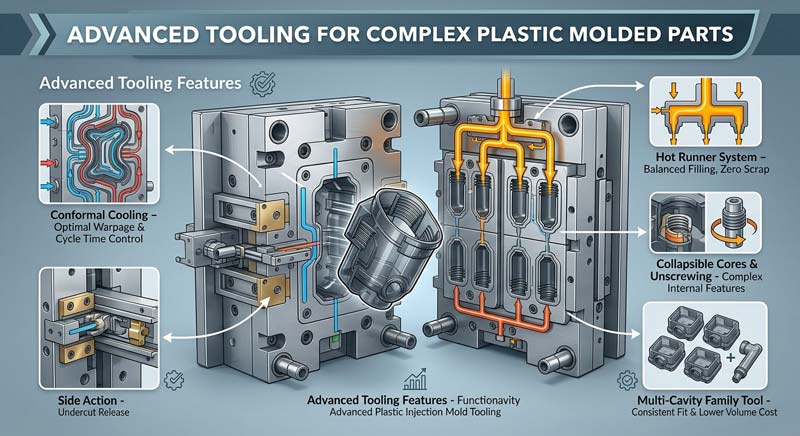
- Side Actions, Slides and Lifters – these move sideways to release undercuts
- Collapsible Cores or Unscrewing Mechanisms – required for parts with certain internal features and threads
- Conformal Cooling – here, the cooling channels follow the flow of the part to help control warpage and cycle time
- Hot Runner Systems – contain heated manifolds and nozzle assemblies to keep the plastic in a molten state throughout the part cavity. This provides balanced and consistent fillings and also means no solid runner is left to scrap.
- Multi-Cavity or Family Tools – multi-cavity tools make several identical parts per cycle. They are ideal for higher runs as they reduce the per-part cost at volume. Family tools will make several different parts at once in the same cycle. Since they are produced from the same material and shot, assembly fit is all but guaranteed.
Budget Impacts of Advanced Tooling
While it’s not possible to give exact numbers here, we can say that a simple single-cavity tool costs a fraction of what a multi-action or multi-cavity tools do. And the gap can be several multiples, depending on requirements and overall complexity. Actual numbers will fluctuate based on material, part size, and region. Generally speaking though, here the factors that contribute to cost:
- Design and Engineering time – greater complexity adds up to more design and engineering time, especially when considering prototyping cycles
- Machining and Build Complexity – every slide, lifter, or other mold feature adds components, fitting and testing
- Longer Lead Times – particularly for the design phase which can be extended by weeks or more for build and sampling
- More Tryout Iterations – especially for assemblies
- Increased Maintenance Costs – more moving parts means more wear points and increased upkeep over the tool’s life. It’s important to maintain your molds on schedule, and keep them in working order to avoid failure or costly (and avoidable) repairs.
Keeping Costs In Check
Intricate parts and assemblies aren’t a problem for experienced molder. Though the do require more complex tooling to be successful. The best advice we can give, and you’ve heard this from us before: involve your injection molding partner early on in the development process. By doing so, you’ll have parts that don’t just look great on screen, but can be produced consistently and reliably again and again.